Are there 8 grades or are there more? It might help to actually first know the three levels, which categorise the grades into different achievement bands.
AMEB grades can be broadly split into three levels, Level 1, 2 and 3.
| Level 1 | Preliminary, Grade 1, Grade 2, Grade 3, Grade 4 | Forming basic techniques and understanding reading and musical concepts |
| Level 2 | Grade 5, Grade 6, Grade 7, Grade 8, Certificate of Performance | A consolidation of musical concepts, encouraging an authentic and musical presentation |
| Level 3 | AmusA and LmusA | A presentation that would be acceptable in a professional setting |
Most students will reach and finish their studies within Level 2, with a select few excellent students ever making it to Level 3. The differences between each of the levels is usually a large and challenging mental shift.
Level 1 (Preliminary-Grade 4)

By the end of Level 1, students are expected to show that they can play the piano with good technique, musical expression, and understanding, not just hit the right notes.
Technique
Students should be able to:
- Sit comfortably and play in a relaxed, natural way
- Use their hands and fingers efficiently, moving smoothly across the keyboard
- Play scales and finger exercises from memory, with correct fingering
- Play clearly and evenly, whether the music is:
- smooth (legato),
- short and detached (staccato), or
- a mix of both
- Coordinate both hands well
- Follow dynamics (soft/loud) and articulation (how notes are played) as written
Pieces and musical expression (how the music sounds)
When performing pieces, students should be able to:
- Play with correct notes, rhythm, and timing
- Keep a steady pulse and rhythm
- Shape phrases so the music sounds musical rather than robotic
- Show contrast between loud and soft playing
- Bring out the melody while keeping the accompaniment quieter
- Adjust tone, touch, and speed slightly for musical effect
- Show understanding of the style and mood of each piece
- Play ornaments (decorative notes) appropriately for the style
Pedalling is not required at this level, though it may be used if a piece naturally calls for it.
Level 2 (Grade 5-Certificate of Performance)
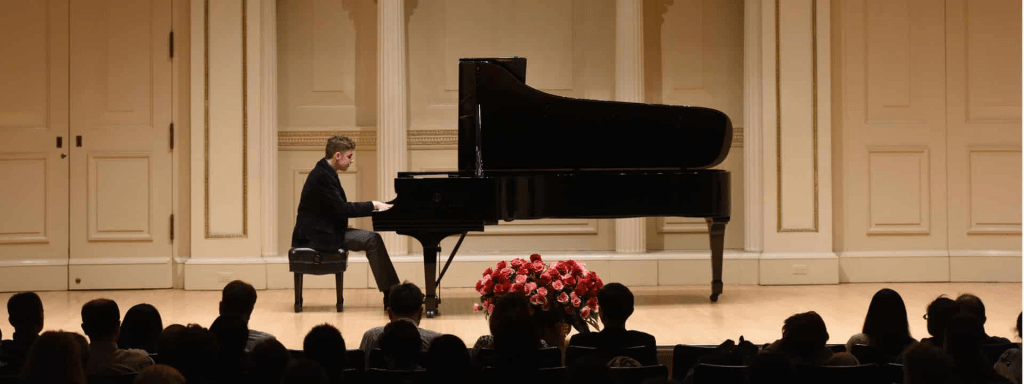
- Level 1: “I can play correctly and musically.”
- Level 2: “I can control the piano, shape the music, and perform with confidence.”
Technique
Compared to Level 1, students must now:
- Play more technical material from memory (including triads as well as scales and arpeggios)
- Show greater control, not just correctness
- Use a wider range of loud and soft playing, with smooth transitions
- Coordinate fingers, hands, arms — and now feet (pedals)
- Sit and play comfortably and confidently
- Move smoothly across the keyboard without tension
- Play fast and slow passages cleanly and clearly
- Control different touches:
- smooth (legato), detached (staccato), everything in between
- Clearly follow all written instructions (loud/soft, accents, articulation)
❗Difference from Level 1:
At Level 2, the focus shifts from basic control to refined control and consistency.
Pieces and musical expression
- Perform pieces fluently and confidently, even when technically demanding
- Show greater emotional depth and contrast
- Use tone colour, not just loud vs soft
- Make musical decisions intentionally, not accidentally
- Use pedal in a convincing and correct manner, not compromising clarity
❗Difference from Level 1:
Level 1 introduces expression, while Level 2 expects expressive playing to be reliable, intentional, and convincing.
Level 3 (AmusA and LmusA)

At Level 3, the examiner is no longer asking “Can you play this well?”
They are asking “Can you present a complete, convincing concert-level performance?”
Technique
- Complete technical mastery
- Technique is no longer noticeable, it is simply assumed
- Able to handle any required technique demanded by the repertoire
- Comfortable with contemporary and extended techniques where required
❗Difference from Level 2:
Level 2 denotes high technical competence, while Level 3 signifies technical authority.
Pieces and musical expression
- Understands the entire structure of each work
- Performs with a sense of long-term direction, not just phrase-by-phrase
- Projects changing moods and character across whole movements or entire works
- Creates a strong sense of unity and identity in each piece
- Curates a full program deliberately
- Repertoire must:
- fit strict time limits,
- show stylistic contrast,
- demonstrate a wide range of techniques,
- and feel artistically balanced
- The program itself is judged, not just the pieces
❗Difference from Level 2:
Level 2 refers to musical expression within the piece, whereas Level 3 encompasses musical storytelling across the whole work and program.
Understanding AMEB piano through these three levels helps clarify what progress truly looks like. While grades measure difficulty, the levels reflect musical growth, independence, and artistic maturity. Level 1 focuses on building solid foundations, Level 2 develops confident control and expressive performance, and Level 3 represents the transition to professional-level musicianship. Not every student needs to reach Level 3 for their studies to be meaningful or successful, for most, completing Level 2 already signifies a high level of musical achievement. What matters most is not how far a student progresses through the levels, but that each stage builds strong skills, musical understanding, and a lasting appreciation for music.
 Piano Lessons and Piano Teacher in Mulgrave